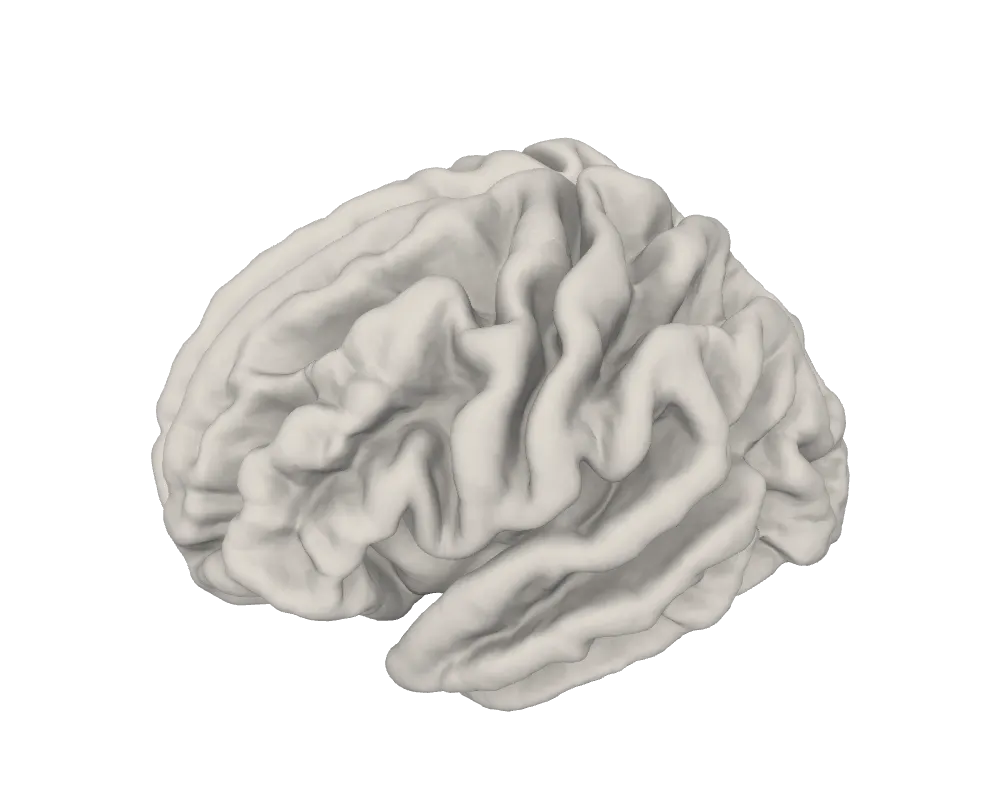
How do you read Drift's brain card?
Nobody was put in a scanner to make it. A model takes a mood's recipe and predicts how an average listener's cortex would respond. The card shows how that differs from Drift's other moods.
In the app a mood paints the wax. Red marks regions the model puts above Drift's other moods. Blue marks regions it puts below. Bare wax means no difference from the rest. The brain on this page shows no mood, so it stays bare.
"Quieter" always means quieter than Drift's other moods. The map has no absolute zero. A brain-imaging signal is only ever a difference between two conditions, and changing the comparison can shrink a result, remove it, or flip its sign.
A region lighting up does not name a mental state. Reading backwards from a region to a thought is not a valid inference. Every line on a card is an association from the literature, not a reading of the listener.
Each association wears a mark for how firmly the literature backs it, by colour and by shape.
- Green, a full disc: replicated or meta-analytic
- Amber, a half disc: reviews or a few studies
- Red, an empty ring: a hypothesis, named as one
The twelve regions
Auditory cortexWhat does the auditory cortex do when you listen to music?
Turning sound into its first description: pitch, timbre and timing.
Busier here is often seen with
- Sound that keeps changing. Moment-to-moment change in timbre and rhythm can be decoded from these regions.
- A split down the middle. Fast timing detail leans left and fine frequency detail leans right.
Quieter here (than Drift's other moods) is often seen with
- Repetition. A repeated or predicted sound draws a smaller response than a new one.
- Attention on another sense. Sound and sight turn each other down.
In Drift
In Drift's music this tends to mean spectral and temporal change, and event density. Bright transients and busy arps sit highest.
Long drones with few onsets sit lowest.
Sources, 6
- Toiviainen et al., 2014, NeuroImage
- Alluri et al., 2012, NeuroImage
- Zatorre, Belin & Penhune, 2002, Trends in Cognitive Sciences
- Bergerbest, Ghahremani & Gabrieli, 2004, Journal of Cognitive Neuroscience
- Barron, Garvert & Behrens, 2016, Philosophical Transactions of the Royal Society B
- Laurienti et al., 2002, Journal of Cognitive Neuroscience
InsulaWhat does the insula do when you hear a beat?
Reading the body's state and flagging what matters now.
Busier here is often seen with
- Different things in different parts. A meta-analysis of 1,768 experiments splits it into a sensorimotor back, an emotional front, a cognitive top.
- A beat. A rhythm meta-analysis finds the insula only in the coarse beat-versus-rest contrast, not in the beat-specific ones.
Quieter here (than Drift's other moods) is often seen with
- Expecting relief. Insular pain responses fall under placebo.
In Drift
In Drift's music this tends to mean rhythmic drive, and the group to treat most carefully. The moods with the most insistent pulse put it highest.
Its base rate across all tasks is high, so a reading here is weak evidence.
CingulateWhat does the cingulate cortex do when you focus?
A belt around the midline that holds a goal and switches between inward and outward attention.
Busier here is often seen with
- Conflict. The front signals that two responses compete and more control is needed.
- Inward thought. The back is a core default-network hub, highest when nothing outside demands attention.
Quieter here (than Drift's other moods) is often seen with
- A demanding external task. Posterior cingulate and precuneus drop reliably when one takes over.
In Drift
In Drift's music this tends to mean very little, and that is the honest reading. This group moves less across Drift's roster than any other named group.
Sources, 7
- Botvinick, Cohen & Carter, 2004, Trends in Cognitive Sciences
- Shackman et al., 2011, Nature Reviews Neuroscience
- Raichle et al., 2001, PNAS
- Buckner, Andrews-Hanna & Schacter, 2008, Annals of the New York Academy of Sciences
- Shulman et al., 1997, Journal of Cognitive Neuroscience
- Anticevic et al., 2012, Trends in Cognitive Sciences
- Leech & Sharp, 2014, Brain
Prefrontal cortexDoes music change activity in the prefrontal cortex?
Holding things in mind and tracking structure as it unfolds.
Busier here is often seen with
- Working-memory load. A meta-analysis of 24 studies puts lateral prefrontal cortex at its centre.
- Harmonic surprise. A chord breaking the expected key raises inferior frontal activity.
Quieter here (than Drift's other moods) is often seen with
- Absorbed, effortless states. This is the transient hypofrontality hypothesis, named as one. A review of 25 studies found the results inconsistent.
In Drift
In Drift's music this tends to mean something our maps and the literature disagree about. Inferior frontal parcels rise on the sparsest, darkest textures and fall on the busiest.
We do not claim that is harmony, and it is unexplained.
Parietal cortexWhat does the parietal cortex do for attention?
Steering attention in space and joining what is sensed to what is known.
Busier here is often seen with
- Goal-directed attention. The intraparietal sulcus carries the top-down half of attention.
- Simple rhythm. Supramarginal gyrus and intraparietal sulcus come up for less complex rhythms rather than for more complex ones.
Quieter here (than Drift's other moods) is often seen with
- A demanding external task. Inferior parietal cortex and precuneus both drop.
In Drift
In Drift's music this tends to mean not much on its own. Three moods put the intraparietal region above the rest and two put it below, and the gaps are small.
Read a small parietal value as noise rather than as a finding.
Motor and touchWhy does the motor cortex respond to music when you sit still?
Moving and feeling touch, on the two strips either side of the central sulcus. The findings below are motor only.
Busier here is often seen with
- Music while sitting still. 42 pooled studies put the precentral gyrus active with no movement.
- A regular beat. Beat-based rhythms raise motor activity where beatless ones do not.
Quieter here (than Drift's other moods) is often seen with
- Rhythm with no findable beat. Motor activity peaks at medium syncopation and falls when a rhythm gets too complex to lock onto.
In Drift
In Drift's music this tends to mean how much of the sound arrives as distinct events rather than as a wash. The subcentral gyrus is the clearest case here.
Temporal cortexWhat does the temporal cortex do with music?
Meaning. What things are. Auditory cortex is a separate group and is not counted here.
Busier here is often seen with
- Retrieving what something means. Middle temporal gyrus is a core node of the semantic network.
- Binding features into a concept. The front of the temporal lobe is the hub where that happens.
Quieter here (than Drift's other moods) is often seen with
- A demanding task. Inferior temporal gyrus is among the regions that drop during one.
In Drift
In Drift's music this tends to mean almost nothing, and the map says so by staying near baseline. Instrumental music with no words is thin material for a system built on meaning.
Occipito-temporalWhat does the occipito-temporal cortex do?
Recognising things by sight: faces, written words, the layout of a place.
Busier here is often seen with
- Scenes. These regions respond to the layout of local space rather than to single objects.
- Faces and written words. Meta-analyses of both land on the fusiform gyrus.
Quieter here (than Drift's other moods) is often seen with
- Seeing the same thing again. Recognition regions give a smaller response to a repeated image.
In Drift
In Drift's music this tends to mean textures the model associates with moving imagery. It was trained on people watching a sitcom and four films, so audio that sat under pictures pulls these up.
That is about the training data, not about anything seen.
Visual cortexCan sound change activity in the visual cortex?
Seeing. The occipital pole takes the first pass, the surrounding gyri build motion and objects.
Busier here is often seen with
- Visual motion. Area MT on the lateral occipital surface is the motion area.
- Sound in the dark. Natural sounds drive decodable patterns here in blindfolded listeners. One laboratory only.
Quieter here (than Drift's other moods) is often seen with
- Attention on sound rather than sight. Three independent groups found auditory attention lowering visual cortex activity.
In Drift
In Drift's music this tends to mean the same film training, at its strongest. After auditory cortex these parcels separate Drift's moods more than any other group.
Cinematic and lo-fi textures push them up, clean focus tones down.
Sources, 7
- Born & Bradley, 2005, Annual Review of Neuroscience
- Tootell et al., 1995, Journal of Neuroscience
- Winlove et al., 2018, Cortex
- Vetter, Smith & Muckli, 2014, Current Biology
- Laurienti et al., 2002, Journal of Cognitive Neuroscience
- Mozolic et al., 2008, BMC Neurology
- Rees, Frith & Lavie, 1997, Science
Memory and limbicHow do the brain's memory regions respond to music?
Tying what happens to where and when. Two parcels a side, and not one system. The parahippocampal gyrus handles place. The anterior collateral sulcus is perirhinal cortex, which handles familiarity.
Busier here is often seen with
- Material that will still be remembered later, across a meta-analysis of 74 studies.
- A place or a spatial layout, on the parahippocampal side.
Quieter here (than Drift's other moods) is often seen with
- Material that already feels familiar, which draws a smaller perirhinal response.
In Drift
In Drift's music this tends to mean nothing we can stand behind. This is the smallest and noisiest group, it mixes two systems, and Drift's moods barely separate it.
OrbitofrontalIs the orbitofrontal cortex the brain's pleasure centre?
Putting a value on what is happening, right now.
Busier here is often seen with
- Subjective value. A meta-analysis of 206 studies puts a general value signal here.
- Music that is enjoyed. Orbitofrontal cortex is one of the clusters recovered across 47 studies of music-evoked emotion.
Quieter here (than Drift's other moods) is often seen with
- The same thing becoming less pleasant. As a food is eaten to fullness, activity falls with rated pleasantness.
In Drift
In Drift's music this tends to mean less than the region's reputation suggests. Two moods push the orbital sulci above the rest and two below, and the split does not match which moods listeners call pleasant.
OtherWhat is the Other group on Drift's brain card?
Nothing. This group is defined and deliberately empty.
Busier here is often seen with
No association. None is claimed.
Quieter here (than Drift's other moods) is often seen with
No association. None is claimed.
In Drift
In Drift's music this tends to mean a bug rather than a finding. Every cortical parcel in the atlas lands in one of the eleven named groups above.
This twelfth exists only so on-device code has somewhere to put a label it does not recognise. A reading here means the preview met an unfamiliar parcel name, and it is worth reporting.
No sources, because no claim is made.
Why it is there at all
The card exists because the moods really do differ, and a picture of where they differ is more honest than an adjective.
It is also easy to over-read. That is why every line above says what the literature links to a region rather than what you are thinking. The science page covers what the research says about focus music itself.
Drift is free to use. Pro is optional. No account, no ads, no tracking.
Get Drift on the App StoreFor iPhone and iPad. Mac with 1.1. Best with headphones.